How Delta 9 THC Is Made & Extracted from Hemp?
Delta 9 THC is the star compound in cannabis, known for its feel-good effects, but here’s something not everyone knows: you can legally get it from hemp. All thanks to the smart extraction techniques and federal guidelines, hemp-derived Delta 9 THC is not only legal but also available in all kinds of products.
So, let’s get into the big question: ‘How is Delta 9 made from hemp?’ In this guide, we’ll walk you through what Delta 9 is, how it’s extracted from hemp, and how it ends up in products like gummies, tinctures, and vapes without breaking any laws.
What Is Delta 9 THC, Exactly?
Delta 9 THC (short for Delta 9-tetrahydrocannabinol) is the main cannabinoid responsible for the classic cannabis high. It’s found in both marijuana and hemp plants, but the major difference is the amount and the legal status.
Under the 2018 Farm Bill, hemp is legal as long as it contains no more than 0.3% Delta 9 THC by dry weight. That tiny number is important. While marijuana can have 10–30% THC, hemp only has trace amounts naturally. But through careful formulation and extraction, producers can legally concentrate Delta 9 from hemp into enjoyable, compliant products.
How Is Delta 9 Made from Hemp?
Let’s clear something up: Delta 9 THC is already present in hemp. But since it’s in such small amounts, you can’t just smoke hemp and expect the same effects as a THC-rich cannabis strain. Instead, we use advanced processing to concentrate it while staying under the 0.3% limit per product.
Here’s a real-world example: If a gummy weighs 5 grams (or 5,000 mg), it can legally contain up to 15 mg of Delta 9 THC and still be compliant. That’s enough to feel the effects, but still totally within the rules.
Another approach is full-spectrum extraction, where multiple cannabinoids (like CBD, CBG, and trace Delta 9) are pulled from the plant together. This preserves the natural synergy between compounds, known as the entourage effect, which can make the experience feel more balanced and effective.
How Is Delta 9 Extracted from Hemp?
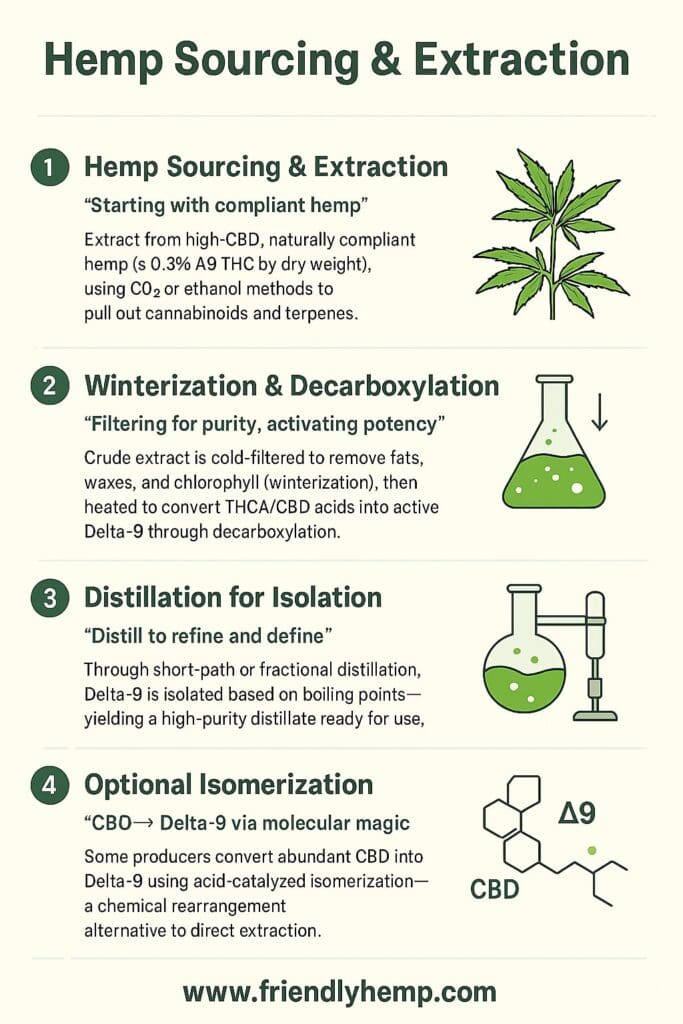
This is where science and craftsmanship meet. There are a few tried-and-true ways of pulling Delta 9 out of hemp. Here’s a breakdown of the most common and effective extraction methods:
- CO₂ Extraction
This method uses pressurized carbon dioxide (CO2) to extract cannabinoids from plant material. It’s super clean, doesn’t leave behind any residue, and is often used to make full-spectrum oils. It’s a favorite in the industry because it preserves both potency and purity.
- Ethanol Extraction
This method involves soaking hemp in food-grade ethanol to dissolve the cannabinoids. Afterward, the ethanol is removed through evaporation. It’s efficient for processing larger batches and, when done right, leaves no trace behind. A lot of large-scale Delta 9 extraction is done this way.
- Solventless Extraction
For those who want something even cleaner, solventless methods like rosin pressing are a great choice. This uses just heat and pressure, no chemicals at all. While the yield is lower, you get a super pure product with zero additives.
- Isomerization from CBD
This one’s a bit more technical. In some cases, manufacturers convert CBD into Delta 9 THC using a process called isomerization. It involves carefully adjusting the molecule’s structure with heat or a catalyst. While it sounds intense, when done in a lab with the right equipment and testing, it’s completely safe and legal, as long as the end product stays within the 0.3% Delta 9 limit.
If you’ve ever wondered how is Delta 9 extracted from hemp, this is where the magic happens. It all depends on what kind of product is being made, the purity levels desired, and how each company approaches quality and compliance.
How Do You Legally Infuse Delta 9 into Products?
Now that you’ve got your Delta 9 extract, how do you put it into products while keeping everything legal? It all comes down to dry weight compliance. Let’s go back to the 5g gummy example. If the Delta 9 THC makes up no more than 0.3% of that weight (15mg), the product is federally legal. This is why you’ll see Delta 9-infused gummies, syrups, and vapes that hit hard but don’t cross any legal lines.
Of course, making sure every batch is compliant means testing, and lots of it. That’s why reputable brands invest in third-party lab testing to verify THC levels and ensure safety from contaminants. You should always look for a Certificate of Analysis (COA) before buying any Delta 9 hemp product. In this way, proper Delta 9 extraction isn’t just about pulling the cannabinoid out; it’s about getting it into a product in a way that’s potent, legal, and safe.
Why Hemp-Derived Delta 9 Is Safe (and Legal)?
Hemp-derived Delta 9 products are 100% legal at the federal level, as long as they meet the dry weight rule and are sourced from industrial hemp. But legality isn’t the only thing that matters.
Safety comes down to clean processing, proper dosing, and full transparency.
The Journal of Analytical Toxicology has noted that unregulated or improperly labeled THC products pose potential risks. That’s why quality brands go the extra mile with full lab reports and safe extraction techniques. If you’re buying from a brand that clearly shares how their Delta 9 extraction process works and backs it up with lab results, you’re in good hands, like we do at Friendly Hemp.
Conclusion
So now you know how is Delta 9 made and how it’s legally and safely extracted from hemp. The process combines modern extraction science with a deep respect for the plant, resulting in products that are both enjoyable and federally compliant.
At Friendly Hemp, we take pride in doing things the right way. From clean CO₂ extractions to carefully formulated edibles, we always make sure every product meets the highest standards. If you’re exploring Delta 9 for the first time or coming back for your go-to favorites, we’ve got something you can trust. Contact us today to grab your favorite Delta 9 product!
You must be logged in to post a comment.
More Similar Posts